
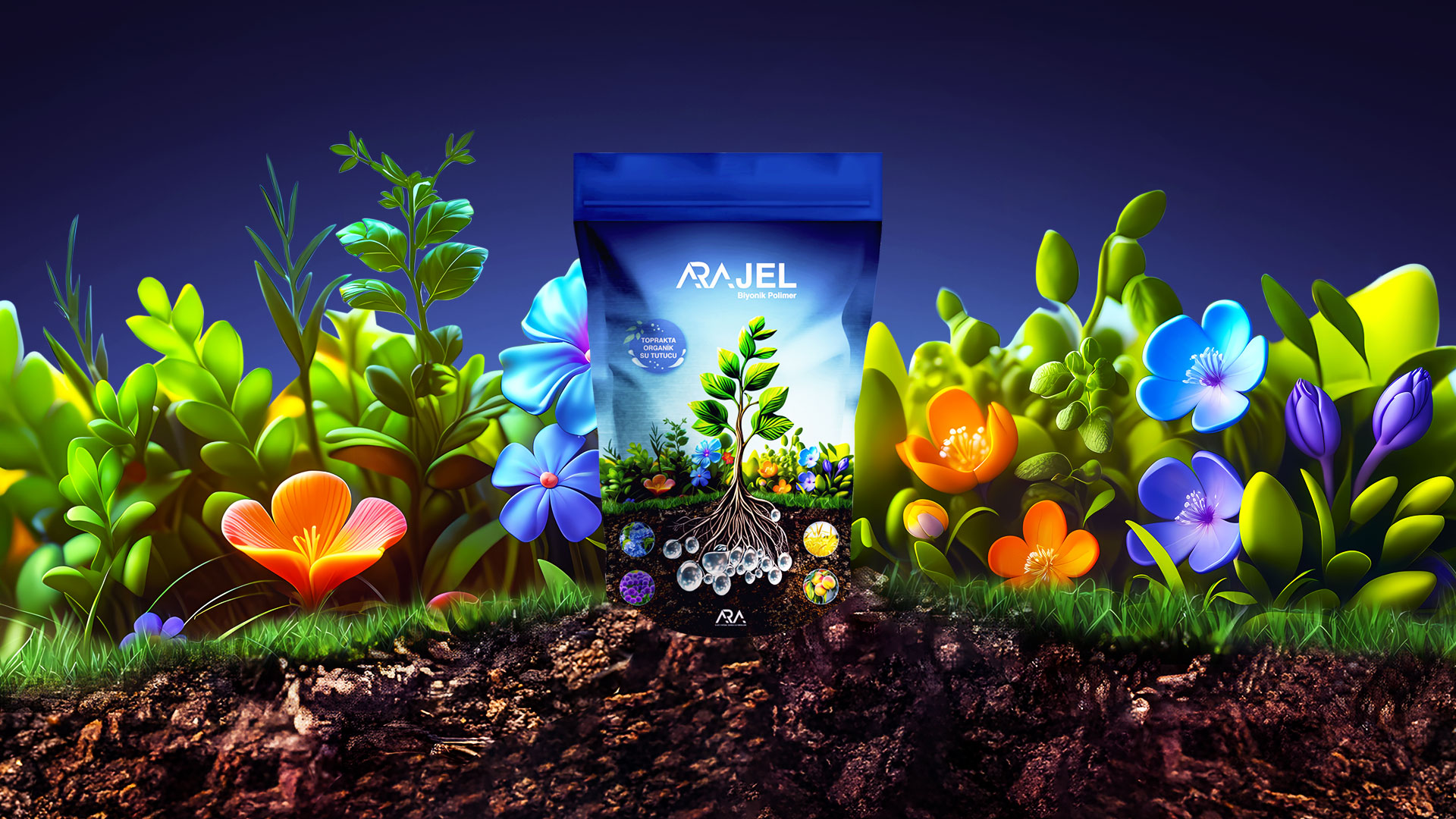
Bionic Polymer
Capable of storing up to 600 times its own weight in water (varies by environment, pressure, temperature, and soil pH), this product releases water to plant roots in a controlled manner during drought. When it rains or irrigation is applied, the hydrogel recharges and stores water again. This cycle continues for 5 years, after which Ara Jel integrates into the soil and naturally biodegrades.
Click here to download the Technical Analysis Report of the Ara Jel product.Storage Conditions:
Can be stored for up to 12 months in its original, unopened packaging in a cool, dry place.
Fruit Growing (Orcharding):
During planting, add 2–3 grams per 1 kg of planting soil, or 1–2 kg per 1 cubic meter of soil, and mix thoroughly. Place this prepared mixture into the seedling’s root zone, cover with normal soil, and irrigate generously. For existing trees, open a trench at the root zone under the canopy projection; add a special mixed soil to the bottom of the trench, sprinkle normal soil on top, and irrigate generously.
Nursery (Seedling Production/Transport):
For preventing water loss and drying of roots during transfer from nurseries to open fields or long-distance transport, perform a bare-root dipping process. Slowly mix 2–3 kg of polymer into 150–200 liters of water to prepare a dipping slurry. For effective results, ensure the slurry attains a consistency that fully adheres to the roots.
Product Characteristics:
This material is a fine powder with a full particle size of 0.2 mm and has a water-retention capacity of 300–600 times its volume. When combined with water, it becomes a hydrogel up to 72 times its volume and remains active in the soil for an average of 5 years. The water absorption time varies with conditions from about thirty minutes to one hour. It is hormone-free, contains no heavy metals, and is non-toxic; it does not harm plant, soil, or human health. It helps germinated seeds survive early spring or late autumn frosts. In the soil, it degrades by about 10–15% per year, and after losing its functional properties, it is naturally decomposed by microorganisms and returned to the environment. It must be protected from sunlight and used entirely below the soil surface in either polymer or gel form. It has a neutral pH (pH = 6–8) and no toxic effect.
Effects on Soil and Plant Health:
By increasing soil porosity, it prevents surface crusting and helps provide the moist environment needed by plants. By reducing evaporation from the soil and thanks to its ion-exchange properties, it slows soil salinization and helps prevent erosion. It also prevents the pollution of surface and groundwater, enabling plant growth under hot and arid climate conditions. It is especially preferred in sandy soils.
Economic Benefits:
While reducing the costs of irrigation, labor, fertilizer, seeds, and energy, it provides significant savings in water consumption. By preventing the damage caused by over-fertilization, it substantially reduces fertilizer use. It also helps increase crop yield.
Afforestation & Reforestation:
It can be used regardless of seasonal conditions in afforestation activities. In plants or newly planted fruit trees, it plays a key role by slowly releasing the water it has absorbed, reducing the risk of first-year drying/mortality in fruit trees by up to 50%. When used together with liquid fertilizer, it supplies the plant with fertilized water regularly. The gel formulation helps protect roots from pests; as it is non-toxic and non-hazardous, it does not harm humans, animals, plants, or the ecosystem.
Protection of Water Resources:
Turkey ranks among the countries that experience water scarcity due to its geographic location. It is projected to be among the most affected countries in the coming years due to drought and global warming. Water is vital for all living beings. However, water resources are rapidly decreasing worldwide, and especially in Turkey. In Turkey, 72% of water resources are used in agriculture, 18% in domestic use (drinking and household), and 10% in industry. By preventing losses of water applied to the soil in agricultural production, maximum efficiency can be achieved from irrigation, making production more efficient.